
Checking Criminal History in Palm Coast
Palm Coast criminal records do not sit in one city database. Start with the office that made or now holds the record. A report about sheriff activity belongs with FCSO, while a filed misdemeanor, felony, criminal-traffic, or ordinance case belongs with the Flagler Clerk. The official Flagler Court Records Search is free for public case queries, and the sheriff provides its own report and custody channels.
- Ask FCSO for the Palm Coast incident or arrest report, using the case number, event date, location, and record type when known.
- Check the FCSO inmate interface for a current or very recent booking at Sheriff Perry Hall Inmate Detention Facility.
- Search the Flagler Clerk by legal name, case number, citation, court type, or filing-date range after charges are filed.
- Contact the Clerk’s criminal counter for a missing image, archived file, certified copy, or registered-user access question.
- Use the paid FDLE Computerized Criminal History search for statewide Florida coverage, or FDLE Personal Review for your own record and correction work.
A name match is a lead, not positive identification. Compare the case number, dates, court division, charge, and disposition. Fingerprint review is the sound route when a shared name or alias creates doubt.
Why Palm Coast Has No City Police Records Office
Palm Coast’s official public-safety information identifies FCSO as the law-enforcement provider. That means a Palm Coast deputy’s incident report is a sheriff record even when the event occurred inside city limits. Palm Coast City Hall does not become the police custodian merely because the address is within Palm Coast.
This arrangement is easy to miss because the city maintains Palm Coast Connect and an Online Records Search for administrative material. Those tools can help with city business, but neither is a criminal-history portal. Sending a sheriff report request there creates an avoidable detour. Use the FCSO public-record channel for sheriff-created police records.
Palm Coast Police Department Records
In practical terms, the “Palm Coast Police Department” function is performed by FCSO. Its permanent District 2 office is at 14 Palm Harbor Village Way, Palm Coast, FL 32137. The Citizens Observer Patrol desk provides information, fingerprinting, and vacation-house-watch help, while the countywide agency handles calls, investigations, arrests, and report custody.
FCSO’s main number is 386-437-4116. Nonemergency dispatch is 386-313-4911, and emergencies go to 911. Email and social media are not round-the-clock reporting channels. A public-record request should describe the kind of report, approximate date and time, place, case number if known, and desired delivery format. Florida law does not require a requester to explain a lawful request for a nonexempt public record.
Some parts may be redacted or withheld, including protected victim information, juvenile material, medical details, personal identifiers, and active-investigation content. Broad requests may also generate an extensive-use charge. Asking for a cost estimate and a citation to any applied exemption keeps the exchange clear.
District 2 Is Palm Coast’s Local Sheriff Door
The District 2 base gives Palm Coast residents a local sheriff contact without changing which agency owns the record. Palm Coast has about 70 miles of canals and Intracoastal waterways and more than 130 miles of trails and paths. That spread helps explain the local district base and the contracted county model.
The Citizens Observer Patrol desk can help with general information and fingerprint services, but it does not replace the records custodian or the Clerk. For an official report copy, use the FCSO records process. For a filed charge and final result, use the court file. For your own statewide identity-history review, follow FDLE’s fingerprint-based personal-review procedure.
Palm Coast Arrests and Bookings
A Palm Coast arrest normally moves from FCSO transport to Sheriff Perry Hall Inmate Detention Facility at 1001 Justice Lane in Bunnell. FCSO creates the booking number, intake time, custody status, initial charges, bond entries, and related identifiers. Detention information is available at 386-586-4873 when the online interface fails.
A booking answers whether the jail received a person. It does not establish guilt and does not guarantee that the State Attorney will file the same charge. After first appearance and prosecutorial review, the Clerk docket becomes the better source for the formal charge, hearings, plea, disposition, and sentence. Readers following the full transition can use the county’s arrest lookup explanation for the broader custody channels.
If someone no longer appears on the county roster, check Florida VINE for custody notifications and FDC Offender Search after a state-prison or supervision transfer. A historic booking that is no longer online may require an FCSO public-record request.
Track a Palm Coast Citation Through the Clerk
A citation issued in Palm Coast is not searched through a separate city criminal portal. The Flagler Clerk reports that traffic citations usually appear in about two business days, though some take three to fourteen days. Searching too soon can produce an empty result even when the citation is valid.
Use the citation or case number when available. If no result appears after the expected interval, contact the Clerk’s Misdemeanor Division at 386-313-4474 or misdemeanor@flaglerclerk.com. Mandatory appearances and some proof matters cannot be handled through an ordinary payment channel, so the docket and notice should control the next step.
Municipal Court Records in Palm Coast
Palm Coast has no separate municipal criminal court lookup. Ordinance violations, criminal traffic matters, misdemeanors, and felonies are handled through Flagler County Court or Circuit Court at the Kim C. Hammond Justice Center. The city label on an incident does not create a city-held criminal docket.
| Court Name | Flagler County Court for misdemeanors, criminal traffic, and ordinance matters; Circuit Court, Seventh Judicial Circuit, for felonies. |
|---|---|
| Case Types Heard | Filed Palm Coast ordinance violations, criminal traffic cases, misdemeanors, and felonies. |
| Case Lookup Channel | Flagler Clerk Court Records Search, public computers, criminal counter, or a records request for older material. |
| What the Docket Shows | Case number, division, filing date, parties, charges, status, events, hearings, documents when public, and disposition. |
| Copies & Fees | Records Management lists $2 per year and name for research, $1 per page, and $2 per document for certification. |
The Clerk’s Misdemeanor Division is at 1769 E. Moody Boulevard, second floor, Bunnell. Public computers are available, and published hours are Monday through Friday, 8 a.m. to 4:30 p.m.
Palm Coast City Search Versus Criminal Records
Palm Coast Connect offers an anonymous-request option, contact fields, and a required description for city administrative records. The separate Online Records Search accepts a record type and wildcard searches. Those systems are useful for city documents, but a hit or no-hit there says nothing conclusive about Palm Coast criminal records.
Use a simple custody rule: Palm Coast administrative work stays with the city; contracted law-enforcement reports stay with FCSO; filed criminal cases stay with the Flagler Clerk. This three-way comparison is the fastest way to avoid asking the right question at the wrong counter.
Palm Coast City Hall Is an Administrative Stop
The official Palm Coast website shows the city government setting that serves administrative requests rather than police-report custody.
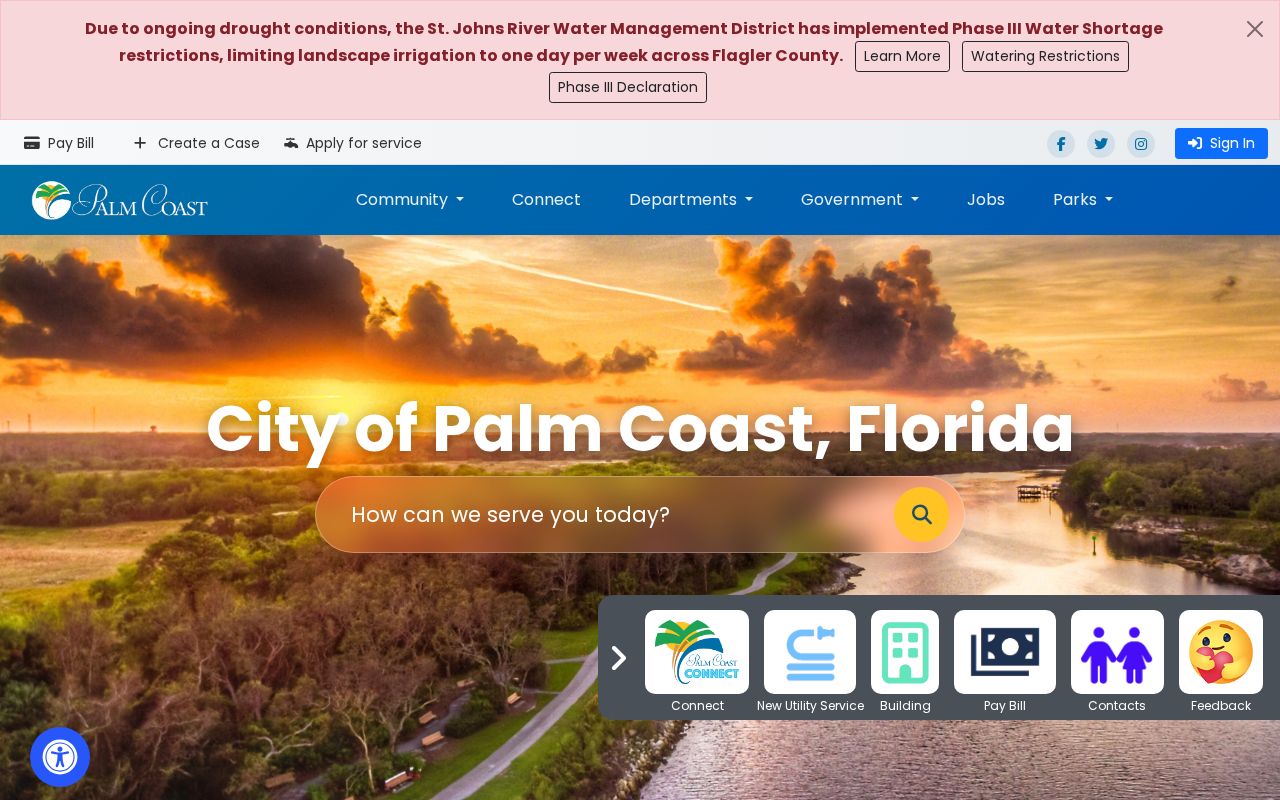
This city source reinforces the local split: use Palm Coast channels for municipal administration and FCSO channels for contracted law-enforcement records.
Where Palm Coast Records Go
A Palm Coast incident starts as an FCSO report. If an arrest follows, FCSO also creates a county booking. The State Attorney decides what charge to file, and the Clerk creates the court case. Fingerprints and eligible arrest data may be reported to FDLE, while the court disposition is later reported back to the state system.
Record flow: Palm Coast contracted FCSO service › Flagler County Courts › Florida Department of Law Enforcement
Timing and identifier mismatches can leave gaps between systems. For recent Palm Coast activity, begin with FCSO. For the filed outcome, use the Clerk. For statewide Florida history, use FDLE’s $24 name search plus its stated $1 card-processing fee. That state product is broader, but it is not fingerprint-positive identification and may lack a disposition that did not match correctly.
Reading Palm Coast Statistics with Care
FCSO has published agency crime-rate changes and related partnership figures. Those numbers cover the agency’s defined jurisdiction and reporting method. They should not be relabeled as a clean Palm-Coast-only crime table, even when an official release discusses the Palm Coast contract.
The same caution applies to records. Calls for service, incident reports, arrests, bookings, filed cases, and convictions are different counts. A Palm Coast criminal-record search should preserve the source year and agency scope, then use the actual case docket to determine what happened in one matter.
Public Access Rules in Palm Coast
Palm Coast police records held by FCSO follow Florida public-record rules, while court files follow judicial confidentiality rules. Public access does not override specific exemptions. A custodian may redact protected data and charge authorized copying or extensive-use costs, but a requester generally need not state a purpose.
Key Statutes:
Florida Constitution article I, section 24 establishes access to government records subject to specific exemptions.
Florida Public Records Law, Chapter 119 governs inspection, copies, fees, exemptions, and custodian duties.
Florida Statutes section 943.053 governs FDLE dissemination of criminal-justice information.
Sealed cases and confidential documents will not appear like ordinary public files. A court dismissal also does not automatically erase every arrest entry. For correction of your own state history, use FDLE Personal Review; for sealing or expunction, FDLE determines certificate eligibility and the circuit court rules on the petition.